
Genesis Chapter Two and 'Who was Adam?'
When studied carefully, Genesis chapter two reveals that Gen. 2:7 is not about the first human. Gen. 2.7 is the first statement of God's intent that humans may attain eternal life - the life which Christ made possible. Genesis chapter two is about the start of that mission. Gen. 5:12 infroms us that the name Adam was given to them, the male-female pair in the garden of Eden. Gen. 5:1-2 first emphasizes that they are a new creation. They are the only humans said to be made in "the likeness of God." Then Gen. 5:2 gives them the name Adam. Adam is not the personal name of the male.
Readers unfamiliar with the above verses are advised to first read the section "The word Adam as name" on page 8.
Video: Genesis 1:1-18 contextualized as a Hebrew of the Exodus
Genesis 1:1-18 contextualized as a Hebrew of the Exodus This video shows that the first 18 verses of Genesis chapter one are a polemic against the first gods of the Heliopolis creation story. It finds that Gen. 1:1-18 is about "Who is God," and "Who is not God."
The Neshmat of the Breath of Lives: How humans differ from the lower animals
This article explains.
- How the translation of two different Hebrew words by "breath" came about.
- The meaning of the word "neshmat."
- The consequences of translating "neshmat" and "ruach" as "breath."
- And makes suggestions about how to resolve the interpretive controversies that resulted from translating two different Hebrew words as "breath."
The word 'vayhiy' in Genesis Chapter One
Support for an Old Earth: All the creative times conclude with 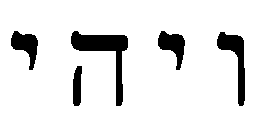 evening, morning, "yom" number. The meaning of as as used in these concluding phrases provides textual evidence supporting the Old Earth interpretation.
Genesis 1:1 and the Revised Translation 'When God began to create . . . .'
This explains why the translation "In the beginning God created . . . " is correct.
Sin, Death, and Redemption as it relates to the Age of the Earth
[Romans 5:12 and 1Corinthians 15:21 ]