Reading Genesis One
Comprehensive Book
The comprehensive translation with detailed commentary, scholarly notes, and complete analysis of the Hebrew text.

A comprehensive translation of Genesis with detailed commentary, scholarly notes, and complete analysis of the Hebrew text.
READING GENESIS ONE differs from the usual book on Genesis. This book is an exposition of the biblical Hebrew which both explains the grammar and determines the meaning of important Hebrew words by reference to other uses of the same word in the Bible itself.
In READING GENESIS ONE the reader is informed about important patterns of biblical Hebrew word and verb usage. This is done by presenting examples which show the biblical Hebrew of other well-understood verses. These verses illustrate and verify the patterns of word and verb use.
The first 35 verses of the Bible describe the history of planet Earth from its beginning through the appearance of Adam (mankind). These 35 verses employ less than 100 different Hebrew words augmented by the prepositional prefixes and the suffixes representing pronouns. As a consequence, the description must omit much detail.
Biblical Hebrew is limited in what it may express because of its small vocabulary. An ordinary American collegiate dictionary will typically define about 160,000 words. Biblical Hebrew, as defined by Strong's numbers, possesses only 8,674 words. This small vocabulary places important limitations on the possible meanings of the verses of Genesis One. Meaning is also limited by the nature of the biblical Hebrew verb. Biblical Hebrew grammars often describe the Hebrew verb as not having tense.
The limitations imposed by the small number of Hebrew words, the Hebrew verb, and other limitations are discussed and consequences explained. This is done before the verses of Genesis One are considered. Subsequently, the first verses of the Bible are studied on a word-by-word basis. Directly comparable examples illustrate word meaning, word construction, and verb usage. This allows the reader to come to an understanding of the meaning which the Hebrew may express.
The meaning which the Hebrew may express often differs from that offered by supposed "experts" who interpret English translation. The meaning also often differs from the meaning ascribed by "agnostic" critics. Resolution of Genesis creation issues is found by direct reference to the biblical Hebrew.
| Reading Genesis One: Comparing Biblical Hebrew with English Translation | |
| Author's Foreword | |
| Chapter One BIBLICAL HEBREW | 2 |
| IMPORTANT FACTS ABOUT BIBLICAL HEBREW | 2 |
| How Words are Written in Biblical Hebrew | 4 |
| Vocabulary: The Multiple Meanings of Words | 5 |
| Word Meaning and the Translation of Genesis One | 6 |
| Nouns, Prefixes, and Suffixes | 7 |
The Untranslated Word
 The Direct Object Marker
| 8 |
| More About Verbs | 8 |
| Biblical Hebrew Verb Does Not Have Tense | 8 |
| The Hebrew Perfect (Completed Action) | 8 |
| The Hebrew Imperfect and the "Waw-consecutive" | 10 |
| The "Waw-consecutive" Verb Form | 11 |
| An Example of Verb Translation | 12 |
| Procedures Followed in the Study of Genesis 1:1 & 2:4 | 13 |
| Chapter Two THE FIRST VERSES: Genesis 1:1-2 | 16 |
| THE FIRST VERSE: GENESIS 1:1 In the Beginning God | 16 |
| The Meaning of Genesis 1:1-18 | 18 |
| THE SECOND VERSE: GENESIS 1:2 Before the Start of the Story | 21 |
The Meaning of
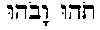 "Tohu" and "Bohu"
| 21 |
| Genesis 1:1-2 Completed Before the "And God said" of Genesis 1:3-24 | 24 |
| Genesis 1:2 Places No Restriction on the Age of Planet Earth | 26 |
Analysis Showing Genesis 1:3 is the Start of the First Creative
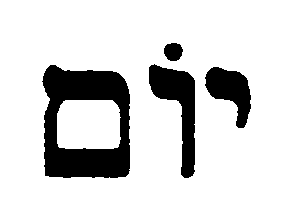 "Yom"
"Yom"
| 27 |
| Analysis of Exodus 20:11-28 | 28 |
| Young Earth and Other Translation Issues | 30 |
| More About "Bara," "Asah," and "Yatsar" | 32 |
| More About "waw + noun --perfect verb," a Pluperfect Indicator | 37 |
| More About "Tohu" and "Bohu" | 43 |
| More About "Haya" Translated "Became" | 47 |
| More About Ex Nihilo | 50 |
| Chapter Three THE FIRST CREATIVE "YOM": GENESIS 1:3-5 | 54 |
| VERSE THREE: GENESIS 1:3 The Start of the "Daytime" | 54 |
| VERSE FOUR: GENESIS 1: 4 About the Separating | 56 |
| VERSE FIVE: GENESIS 1:5 The Naming and the Concluding Phrases | 58 |
|
The Use of
"Yom" in the Five Books of Moses and the Hebrew Bible
| 60 |
|
Translation and the Time Meaning of the Creative
"Yom"
| 67 |
| Summary of Results for Genesis 1:1-5 and Comments Regarding 24-Hour "Day" Models | 70 |
| The Translation of Genesis 1:3-5 | 74 |
| More About "Evening" and "Morning" | 79 |
| Yom as a Marker of the Passage of Time | 81 |
| When "Yom" Means 24 Hours | 84 |
| History of the English Genesis One Text | 88 |
| Chapter Four THE REMAINING CREATIVE "YOM" | 90 |
| The Second Creative "Yom": Genesis 1:6-8 The Sky and the Waters | 90 |
| A Model of the Sky and the Waters | 92 |
| The Translation of Genesis 1:6-8 | 94 |
| The Third Creative "Yom:" Genesis 1:9-13 The Land and the Land Plants | 96 |
| The "When" of Genesis 1:12: A Pluperfect Reference to Past Actions | 97 |
| The Words Translated Grass and Tree | 100 |
| The Fourth Creative "Yom": Genesis 1:14-19 The Lights in the Sky | 102 |
| The "When" of the Actions of Genesis 1:14-18, the Pluperfect References to Past Actions | 106 |
| About the "Patterning" of Genesis One | 108 |
| The Fifth Creative "Yom": Genesis 1:20-23 Air Breathing Creatures in the Waters | 110 |
| Creatures in the Waters | 110 |
| The Methods Used by God to Introduce Plants, Air Breathing Life, and Fill the Waters | 116 |
| The Sixth Creative "Yom": Genesis 1:24-31 Land Animals and the Creation of Adam | 121 |
| The Land Animals | 121 |
| Adam: Male and Female | 123 |
| The Seventh Creative "Yom": Genesis 2:1-4 The Ceasing of the Seventh Time | 130 |
| Concluding Remarks | 134 |
| Chapter Five THE TRANSLATIONS OF GENESIS ONE | 139 |
| This Study's "Good English" Translation | 140 |
| This Study's "Good English" Translation of Genesis One with Strong's Numbers | 146 |
| Appendixes and Verse Indexes | 151 |
| Appendix 1: English Transliterations Used in the Text for Hebrew words | 152 |
| Table of Hebrew Letters with Name and Strong's Articulation | 154 |
| Appendix 2: Strong's Numbers and Hebrew Root Word Phonetic Representations | 155 |
| Index of the Hebrew Text of Genesis 1:1 - Genesis 2:4 | 158 |
| Index of Referenced Verses (Not the verses of Genesis 1:1 - Genesis 2:4) | 159 |
| End Notes | 160 |
READING GENESIS ONE is a book about God's creation. This book is a powerful tool for resolving creation issues in Christian witness. Why? Because its readers can study and understand the first 35 Hebrew verses of theBible directly, for themselves. They can free themselves from dependence on asserted "expert" opinion.
Why this approach? Because many arguments about the Bible and its agreement or disagreementwith the historical physical record are flawed. They are flawed because the Bible does not say that which the disputing parties claim. This may be either the Bible critic or the Bible advocate. In some cases both are arguing positions which are not in agreement with the biblical text.
Based on the substantiated verb and word use, this book establishes and explains that:
1. Genesis One does not say that the Earth is "young," i.e., about 10,000 years old. This fact is established independent of any interpretation about the length of the six "days" of creation.
2. The translation chosen for the Hebrew word "yom" is shown to not determine the age of the Earth, or the age of the universe. It is also shown that the time between the first "And God said" of Genesis 1:3 and the completion stated in Genesis 2:1 is not limited to 144 hours. An interval of 144 hours (six 24-hour days) is not a required consequence of interpreting the creative "yom" as six 24-hour days. When this fact is understood, many of the often encountered arguments are found to be pointless exercises.
3. Genesis One and the established physical history of planet Earth are not in conflict. There remains a conflict with the interpretations of Darwinism.
4. READING GENESIS ONE explains and critiques the typical arguments by which advocates of the "Young Earth" position arrive at their conclusion.
Choose from our comprehensive book or start with the free booklet. Discover how Genesis supports both faith and science.
Comprehensive Book
The comprehensive translation with detailed commentary, scholarly notes, and complete analysis of the Hebrew text.
Free Booklet
Introduction to key concepts showing how Genesis supports an ancient earth. Perfect starting point for this research.
"Rodney Whitefield has undertaken a study of Biblical Hebrew that is far more intensive than most seminary-trained students have done. He has carefully examined the text of Genesis One in the original Hebrew as well as in ancient translations (the Targums, the Septuagint, and the Vulgate). Also he has consulted all the English versions plus ancient and modern commentaries, and recognized grammarians such as S. R. Driver, Kautzsch and Crowley, Menahem Mansoor, and Ziony Zevit. His resulting translation provides the most detailed and thorough explanation of Genesis One available to the general English reader today. Repeatedly he clarifies that the Hebrew word yom does not refer to twenty-four hours regarding the length of the six creation days. His exposition will be of great benefit to those seeking a fuller understanding of the original meaning as intended throughout Genesis One."